
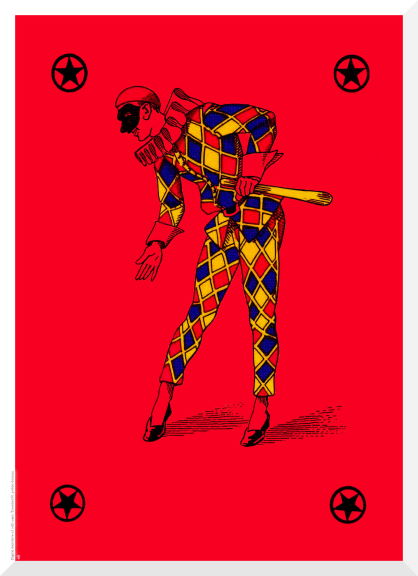
By his own estimation of the waters you did not need to know much about Piero to know things were looking decidedly lumpy. His wife had left him two years before for a fisherman; his one and only daughter had moved to the north – apparently also in pursuit of a fisherman; as a consequence, Piero spent most of his time fishing in the bars of the old town.
The impresario was on the phone when Piero entered his office. He nodded and Piero sat down to wait for him to finish.
There was a tray of coffee cups and a plate with a half-eaten pastry cake. A cigar burned in the ashtray as the impresario jabbed his finger at the receiver. “Senti, discutiamo questo dopo. The main thing is we have the theatre booked….”
Letting the impresario’s voice wash over him, Piero stared round the room, looking at all the posters on the walls. If he knew all of the acts; in fact, had even worked with most if not all of them at one time or other; tucked away in the corner, there was even one of himself in his clown’s uniform. “Il Pagliaccio,” it read, “arriva a Carnivale. Porta tutti i bambini a vedere Piero il vero bambino.”
(The Clown is coming to Carnival: bring the kids to see the real kid!)
Piero grimaced when he saw the poster.
The impresario put down the phone and looked up.
Piero the clown smiled back.
“Vecchio amico, come va? Tutto a posto?”
“Non si puo’ lamentare. Mustn’t grumble,” said Piero. “E tu?”
“Non c’è male,” said the impresario.
Piero asked after impresario’s wife, his young children, his villa in the country. Piero did the small talk, the chitchat. “E gli affari? How’s business?”
“Be’,” said the impresario, “non si può lamentare.”
“And you, Piero?”
“Be’, he said, “non si può lamentare. Mustn’t grumble.”
If they were skirting around it, the impresario finally picked up the cigar from the ashtray and raised his eyebrow in Piero’s direction.
“Quindi,” he said, “what can I do for you?”
Piero shifted uneasily in his chair. “Well,” he said, “you know how it is, Tony. Since that last gig in May, I haven’t had anything coming my way…. Mi stavo chiedendo. I was wondering if you have anything for me now.”
Piero waxed about his new routine. He was going to introduce a dead parrot, he told the impresario. “It’s going to be a great little sketch,” he said. “The joke is I am going to try and bring it back to life.”
“What, the sketch?”
“Of course,” said Piero, keeping his cool, “I’m going to do that. However, I was talking about the parrot.”
The impresario drew on his cigar. The cigar had gone out.
He reached for a lighter and held the flame over the cigar. It took several puffs before he got it to light.
Piero broached the subject of a TV slot. “If I can raise my profile,” he said. “You could get me more gigs.”
He looked at the impresario.
“Piero,” he said, dragging once again on his cigar, “you know how it is…”
Yes, thought Piero, of course I know how it is.
The impresario began to reel off names that were both familiar and unfamiliar to Piero: Mago Forrest, the bungling magician, La Buffala, the loudmouthed Neapolitan, Toto e Tata, this week’s flavour of the month… He talked about dates, fixtures. He might as well have been talking about fittings and inside leg measurements.
The phone rang.
“Excuse me, Piero…”
The impresario took the call. His voice boomed down the phone. “Cazzo! Cos’è successo? – Beppe!”
Piero felt sick to his stomach…
He did not bother to wait this time for the end of the phone call.
He stood up, waving to the impresario.
The impresario looked up but did not wave back as he left the office…
Piero walked down towards the seafront. In Bar Piccolo he bought a beer and stood in silent communion with Fredo at the bar until the old lawyer Menzini wandered in, cigarette in hand.
The lawyer ordered an apertivo and stood coughing his lungs out. Once he got his voice back, he began, as was his custom, to cast ironic aspersions on the competence of the tribunal clerks.
“Sono pagliacci!” he said. “They’re a bunch of clowns, if you will pardon the expression, Piero. But when will they ever find those documents? It doesn’t make any difference. Five, ten days. The answer’s always the same. Come back in five, ten days.”
Piero shrugged.
“Clowns shouldn’t be working in the Tribune, avvocato.”
The old lawyer started chuckling. As he did, he began to cough again.
They waited for him to overcome his faulty lungs. If smoking was now banned, no one, least of all Fredo was willing to stop the old lawyer committing his oldest vice.
“Well,” the lawyer said finally, “it’s more like a circus than a law court. Ma cosa dobbiamo fare? But what can we do?”
“Indeed, avvocato, what can we do?”
Someone came into to buy a scratch card. Fredo went round the back of the shop.
Piero nodded to Fredo; he saluted the old lawyer and walked back out onto the street. He cut across the piazzetta and crossed over the main road. He walked up towards the old town. Here, in the N’derr la lanz, on the side of the road, he bought some mussels from one of the fishermen.
He watched him open the mussels onto a plastic plate. The fishermen worked fast, slipping the knife between the edges of the shell. “Vedi come sono buone,” he said.
Piero licked his lips. “Sono buonissime!”
He ate the mussels raw in their liquid and washed them down again with another beer.
When he had finished his feast, he took the rest of his beer and went and sat on the jetty. He looked over at the old, abandoned Margherita theatre and the Circolo Velo, hidden under scaffolding.
“Isn’t it wonderful?” someone said behind him.
Piero looked round.
It was a young woman. She must have been around the same age as his daughter.
“Indeed,” he said. “It’s beautiful. Molto bello stasera.”
For a second he paused. “It almost matches my melancholy.”
The young woman looked at him. “Why? Are you sad?”
“No,” said Piero. “However, it is the nature of my profession to be attuned to sadness.”
“What do you do?” she asked.
“I work in the circus,” he said.
“Oh, I thought clowns were supposed to be happy.”
“Young lady,” he said. “In all clowns there is a little sadness. Only when he understands what makes him sad can a clown make people laugh.”
The young woman smiled. Then she turned away to look at the view.
They sat in silence. Piero stared out to sea.
To his surprise, when he looked round again, the young woman had removed her clothes. She was sitting in her underwear.
“Signorina, excuse me,” he said, turning away, abashed.
“Why should you be sorry?” was her reply. “Anyway, it’s such a lovely evening I think I will go for a swim.”
The young woman slipped off the jetty and into the water.
Piero watched her as she swam out between the fishing smacks and the cabin cruisers.
“Why not,” he said to himself. “It’s such a lovely evening.”
Piero began to undress.
He took off his shoes and trousers. He folded them and put them on the jetty.
Finally, he stood in his boxer shorts.
“What do I need these for?” he told himself.
Piero slipped over the edge of the jetty and dropped into the water.
He swam out between the fishing smacks and cabin cruisers.
When he came to the end of the moorings, Piero kept swimming.
I wonder where she’s got to, he asked himself.
But the young woman had disappeared.
Piero swam on, past the harbour wall.
When he looked up again, it was dark all around him.
The lights from the shore were but specks.
But he did not feel like turning back.
“It’s now or never,” he told himself. “It’s time to let go.”
“Here,” said a voice. “Take a hold of this.”
Piero looked up.
The fisherman was standing up in his boat with a pole. “Hold on to it,” he said. “I’ll pull you in.”
“You must be freezing,” said the fisherman. “I’ve got a blanket in the back. You’d be surprised how cold it gets at night.”
The fisherman handed him the blanket.
“Cazzo,” said Piero, as he sat down in the boat, “I can’t even let go properly.” “Let go of what?” said the fisherman.