
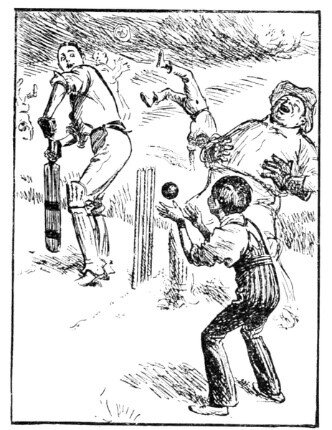
As a rule, I rather enjoy watching the cricket. I have always thought it a nice way to spend a summer afternoon. You can chat with friends, spice up a cucumber sandwich with a drink, and if you so choose, get merry.
The ground was situated behind the Forelock Arms where the two marquee tents had been set up. One for our team the Forelans, and the other for the Farrell’s.
“Is that the last of the crates?”
“Yes, Mr. Good.”
“And the glasses?”
“They’re under the table, Mr. Good.”
“Perfect. – Off you go and get changed then.”
“Right-o, Mr. Good.”
Gerald, that is Mister Good looked round at me and chuckled.
“Looks like Sandpaper’s late.”
“Well,” I said, “that is a turn up for the books. Sandy is always a stickler for time.”
The opposition Captain, Sandy was indeed late by his stickling standards. I watched as his four-wheel drive churned up the gravel and he hopped out. Sandy, I noted, was in a state of agitation that only one who knew him so well would recognise. One new pale ale had been left behind. It was all the fault of Frenchy, who forgot to remind him before they left the warehouse. And they had to go back for it, which is why they were running late and had to make the diversion. I remember as he was saying this looking around at Frenchy, who I realised must have been Sandy’s new girlfriend. She was a pretty little thing in a floaty summer dress and a straw hat. She looked quite unconcerned – or so I thought by Sandy’s criticism. It was ever thus as far as his cricket was concerned.
Sandy looked pointedly at his watch.
“The match is due to start in fifteen,” he said. “I need to go and change.”
“Don’t worry, Sandy,” she said. “I’m sure we’ll manage without you.”
In all that time you may note Sandy had not said a word of greeting to me as he chucked the keys at Frenchy.
Frenchy opened up the boot.
There were several large crates (the Farrell bitter) as well as some smaller crates, including the pale ale. Ladies beers, Sandy calls them.
“Are you alright with that?” I asked.
“Of course,” she said, “I put a shift in the Forelock in the old days.”
“Really? – I’ve been going to the Forelock for years, but I don’t recall ever seeing you around.”
“That was before I ran away to London.”
“Like Dick Whittington.”
Frenchy laughed.
“More like the puss in boots.”
I was amused because of the way she said it.
“Ah, there you are Cameron David!”
Sandy’s lieutenant had come over to help. He was already in his make do whites. I say make do because there was always something about them that made you think he had tippexed over the grass stains.
“Hello, Cameron,” I said.
“Mary,” he said, “I didn’t realise you were coming.”
“Cameron, darling,” I said, “I wouldn’t have missed this mismatch for all the tea in Chipping Norton.”
“Very droll, Mary.”
Sandy won the toss and elected to bat.
The Forlans were still waiting for their eleventh man.
Gerald asked if they could borrow one of Sandy’s men.
“I think we can stretch to that,” he said. “Only you owe us a run for every minute your number eleven’s late.”
It was Sandy’s idea of a joke, but only Cameron David laughed.
“Just teasing, Gerald. Do you know if he’s actually coming?”
Mr. Good shrugged and turned to one of his teammates.
“Desmond, have you heard from Wanders?”
“He just left me a message to say he’s on his way. Be here in ten according to his sat nav.”
“In that case,” said Sandy, “you won’t give away too many runs.”
“Well, Sandy,” said Mister Good, “you know what I say in these situations. What goes around comes around.”
Sandy could not resist it.
“I hardly think we’re playing a game of rounders, Mister Good.”
Then I heard, to my surprise, Frenchy say under her breath:
“God, he’s such a prat.”
“An extremely cunning prat.”
“What do you mean?”
“You watch. He’ll find a way to make them pay.”
Meanwhile, Cameron David was doing that flexing thing. Bending his knees in his pads and twisting from side to side while he propped himself up by his bat. This, I suppose, was to demonstrate, vigour, keenness and general readiness for play.
“Skipper, who’s umpiring?”
“I’ll do it until the first wicket down. Then when we’ll just play it by ear.”
To explain – and sorry for those of you don’t know much about cricket, Sandy always came in at number four – because he said it was the best position to bat when the shine is off the ball – and usually if a wicket went down, you could count on the ball to lose its shine by the fifth over. He always counted on umpiring through the first five overs.
“See what I mean,” I said, turning to Frenchy.
“Sorry, I don’t.”
“Never mind. Would you care a glass of Forlan’s champagne?”
“What a good idea!”
About ten minutes into the game Max Wanders turned up in a Maserati Convertible, spraying gravel all over the other parked cars, much to their owners’ annoyance. He got out and strode towards the pub, calling out:
“Excuse me… I am here for the game of cricket.”
This was uttered in a continental accent that had some spectators muttering into their glassware.
He was, I have to confess, a glorious sight, dressed in whites that were more appropriate to some Mediterranean night club, and noticeably tight in all the right places. In his mouth was a Gaulois cigarette and perched on the end of his nose was a pair of classic Ray-bans.
Someone said:
“You’re supposed to be out on the field.”
“Monsieur, I cannot possibly go out onto any field without a coffee.”
A few minutes later he emerged from the pub with an expresso cup and ambled onto the field, puffing at his cigarette.
Gerald, who was behind the stumps, called to him:
“Ah, Mr. Wanders, would you mind going down to fine leg?”
Wanders stopped in his tracks and looked down at his trousers.
“They are fashion, yes?”
“Absolutely,” said Gerald, smiling. “Very fashionable for cricket.”
Sandy, who was standing at square leg, pointed and said:
“He means to stand over there.”
“In that case,” said Wanders striding up to him, “can I give you my cup?”
As he handed the cup to the speechless umpire, he tapped his cigarette onto the saucer, turned and ambled to his allotted position.
“Have you ever seen anyone look so cool on a cricket field?”
“Did you see Sandy’s face?”
“It was a picture.”
“Priceless – Oh, I say.”
I stopped in my tracks, for Cameron David was suddenly clean bowled.
“Well, I don’t suppose he could do anything about that.”
“No, I don’t suppose he could.”
Frenchy and I watched as Sandy’s lieutenant left the field. He looked utterly deflated, his bat seemingly drooping between his legs.
I could not resist:
“Hard luck, Cameron David.”
Frenchy looked at me and giggled.
“You are so terribly naughty, Mary.”
“I know, and so are you, darling.”
At lunch the Farrell innings was still going strong. They were five men down for a hundred and twenty, and Sandy, who had entered the fray, as predicted after the fifth over, was still in. He was thirty-five not out, and I thought in a rather sprightly mood, as everyone milled around the buffet. By now, however, Frenchy, the other girls and I were all rather merry. I was having an entertaining conversation with Desmond and Gordon about the state of their property portfolios. They had invested together in a couple of houses in some part of South London I had never heard of, and it was all apparently going rather well. And rather amusingly they wanted me to invest as well. Meanwhile, Frenchy and Wanders were chit-chatting away. One could not mistake the odd light-headed chuckle from Frenchy as Wanders offered her one of his Gaulois, which must have been rather irritating for Sandy, who I knew disapproved of smoking, when I heard him say:
“You’re not being very loyal.”
“What’s loyalty got to do with it?”
“Strange as it may seem, we are also here to promote the new ale.”
“Well, I happen to prefer champers.”
“It’s not champers, it’s English sparkling wine.”
“Ah, there you are, Mary! I need some more of the Forlan’s champagne.”
“Of course,” I said, turning around to the two Forlan players, “Desmond, Gordon! What about you two? – Would you care some of the champagne?”
“I rather think we better not.”
“No, better not. Before long we’ll have to go out to bat. As long as Sandy lets us.”
“Mind you, I do think he’s batting jolly well.”
For a moment Sandy looked at them both with a rather quizzical expression. Were Gordon and Desmond being friendly or taking the Michael?
“I better go and find someone to umpire.”
“Well,” I said, “I am sure Cameron David will be up for it.”
“You watch,” I continued under my breath, “he’ll be not out at the end of the innings.”
Once again, Frenchy started giggling. In fact, she practically snorted up her champagne.
“Mary,” she said, “you are so very naughty.”
“So too, my dear, are you.”
We tipped glasses and toasted Desmond and Gordon.
“Boys,” I said, “we really are looking forward to seeing you bat.”
As things turned out, and slightly against my predictions, Sandy got out soon after lunch – just one short of his fifty, caught with the faintest of nicks by Mr. Good behind. All, however, was not quite lost. In the last 10 overs or so there was a good sixth wicket partnership between two of the younger boys, Fergus and Finn Brownlee, who had been coaxed by their dad to play instead of two of the Farrell regulars who were otherwise though I doubt very much usefully engaged inside the Forelock. Sandpaper shook both their hands as they came off the pitch together. Finn was caught in the covers off the last ball of the innings; they had taken another fifty runs to leave the score at 190 for 7. Not a bad effort in the circumstances.
The two Nigerians, Desmond and Gordon, now came out to start the Forlan innings. For the keener observers around the ground the beauty of their technique was something to behold. They saw off the new ball comfortably, and slowly, and progressively, began to open up with shots all around the ground. Their mid-pitch chatter was highlighted by its consistency, encouragement and politeness. Desmond would say: “I say, jolly good shot.” Gordon would return: “Sorry, I forgot to say wait.” And Sandy would look an increasingly whiter shade of pale as the scoreboard ticked over. They just did not want to get out. The fifty was brought up, then the hundred. They were a hundred and twenty-five for nought when the Big Commotion happened.
Colin the carpenter had been minding his own business with his two spaniels as he waited his turn to bat. The dogs, although subdued by the heat, could not resist the temptation of chasing the pub cat, Smokey, who had inadvertently wandered onto the field. To be fair it would not have been much of a commotion if the dogs had not been tied – optimistically – to a couple of camping chairs. Their pursuit resulted in a trail of outdoor furniture and glasses being strewn across the outfield. Colin was mildly oblivious as he puffed on his fine Dutch tobacco. He muttered: “Oh, bugger!” and set off in pursuit of the dog and cat show.
You may have noted I am seasoned observer of Sandy, but it was only later I understood what he had done. While all this commotion was going on, Sandy ran over to the far boundary where no one was watching and where he had left his jumper with another ball hidden in it. The ball was used, but in a better condition than the one in use, with one side polished and one side scuffed up. Without getting too technical – the balance between the polished and scuffed up side enables the bowler to get unexpected and therefore surprising lateral movement – enough to confound two skilful batters such as our Gordon and Desmond.
When the dogs had been retrieved by their Master and Smokey had disappeared into the bushes, Sandy came back with his jumper and the new ball. He had decided to change the bowler, and he gave the new ball to his own faithful cocker spaniel, Cameron David.
I have been watching men’s cricket a long time. In fact, you might say I have made a study of it. Their movements in the field. The way they unconsciously rub the ball against their nether regions, or more vigorously down their flanks. And Cameron David, I must admit, was one of the more vigorous rubbers of the ball.
In the space of two overs Desmond and Gordon had been removed. Caught in the slips. With Cameron David’s new-found ability to swing the ball, Sandy’s team begin to tear through the Forlan until they were down to Mr Good, who refused to get out as a matter of principle. Slowly the Forlans inched their way towards the Farrell score. All wickets had fallen until the last man in: Wanders. There were six runs to win and three balls left of the forty overs.
Wander’s first ball whizzed past his nose. Mr Good charged down the pitch, and they managed to run a bye. Mr Good then struck the ball firmly for what he thought would be two runs, but Cameron David was lurking with a powerful throw from long off. This, unfortunately, left Wanders facing the last ball, and I could see Mr Good cursing himself at his misjudgment. He wandered down the pitch for a quick conference with the naïve batsmen.
“I’m sorry, Wanders, for leaving you with the last ball.”
“That’s no problem, Mr. Good. What do you want me to do?”
“In polite terms, watch the ball like a hawk and hit it as hard as you can.”
Wanders nodded slowly.
“Would that be like a double handed forehand at Wimbledon?”
“Something like that,” said Mr. Good, turning on his heel.
As expected, Sandy’s tyro tore in and delivered what he considered to be the perfect bouncer.
At the other end Wanders performed what he considered the perfect forehand winner, striking the ball on the up and launching it over mid-wicket for six.
Much to everyone’s surprise, the Forlans had won.
“Oh, my God, Wanders!” said Frenchy, grabbing him by the arm as he wandered towards the pub and the plaudits. “It might be disloyal to say this, but that was a wonderful shot!”
“You know, honestly. Mr Good is a wonderful captain. He told me to play a shot like Wimbledon.”
“You played at Wimbledon?”
“As a junior. Then I found there is more to life than tennis.”
Frenchy was impressed.
“Wow! You played at Wimbledon!”
At the point I thought I needed to step in before Frenchy swooned completely before the dashing Belgian.
“Well played, Max! Let’s me trade you a glass of fizz for a Gaulois.”
“Fair deal. I really quite like this Forlans Champagne.”
“Oh, look!” cried Frenchy. “The band has arrived.”
“Paco and the Snake Boots!”
“What sort of band are they?” asked Wanders.
“I have no idea,” said Frenchy, looking around at me.
“Mexican folk, I think. Though, I hear they do a great cover of Thunderstruck[1].”
“Oh, please tell me it’s not going to rain,” said Wanders.
“Raining Men,” I said.
“Oh, Mary,” said Frenchy, “you are naughty!”
“So, my dear, are you!”
So, the scene settled. The sun dipping over the Cotswolds. The insects floating through its last rays. Chatter and laughter round the hog roast. The clink of glassware from the bar.
The band played a short set and then handed over to a DJ while they ate their supper. The competition was not over as each side tried to persuade the other to drink more of their imported boissons.
“I must admit I did find rather suspicious, Desmond, when you and I were going so strong, and the ball started dipping around like a firefly on acid.”
“Do you remember at Pidley when we were still batting and were required urgently in our codpieces for Rosencrantz and Guildernstern.”
“You were doing Hamlet.”
“No, Tom Stoppard.”
“That old thesp who ran drama was a friend of his. An extraordinary gentleman. He used to act with Peggy Ashcroft and George Devine.”
“How can one forget, Gordon.”
“Did you go to Pidley for the drama?”
“Actually, we went on a cricket scholarship from Lagos Higher. However, we enjoyed the drama rather more. After all, in drama you can pretend to be anyone. Especially a Prince who sends emails.”
“Mister Good, have you still got the match ball?”
“I think it was lost in the bushes off the last shot,” said Gerald, ever the diplomat.
Without a doubt it had not been Sandy’s day. Despite all his best efforts, they had been thwarted once again. To make matters worse, he had bought so much beer he was going to have to take some of it home again.
Then he saw Frenchy deep in conversation with Wanders, who had his arm draped over her cardiganed shoulder.
Spotting Gerald with the Nigerians, he sidled over.
“I say, Good. Your number eleven is being rather over familiar with my opening bat.”
I could not resist:
“Has Cameron taken to wearing a dress?”
“No,” said Sandy. “You know exactly who I mean.”
“There’s no need for a scene,” said Gerald, eyeing me to come and assist.
We walked over to the offending couple.
“Wanders,” said Gerald. “That was such an amazing shot. Come now, as I’m about to do the speeches.”
Everyone was amused. The speeches appeared to wrap up the evening. Even though the band was still playing, people began to drift off home.
I was at the bar rolling a cigarette with Colin when I saw Frenchy leaning into someone. It was not Sandy or Wanders. It was Gerald.
I distinctly heard her say:
“I rather like this English champagne.”
Gerald smiled and said:
“It’s a pity we can’t call it champagne. It still wins all the prizes.”
“Well, it’s won the prize with me. Can I trouble you for a top up?”
Sandy found me a little while later as I was enjoying the remnants of the Dutch tobacco.
“Where are they?” he said.
“Where’s who?”
“Frenchy and Wanders.”
“Oh, that’s funny. I put Wanders into a taxi half an hour ago.”
Sandy’s face dropped.
“Come on,” I said. “I think I should put you in a taxi, too.”
“I don’t want to.”
“No, Sandy. It’s time to call it a day.”
At that moment it was hard not to feel sorry for him, although I knew better. As one of our friends was wont to say: we call him Sandpaper because anytime you deal with him, he rubs the skin off your knuckles.
As Sandy’s taxi turned into the main road, I looked around.
There was still no sign of Frenchy. However, standing outside the pub, with his Gaulois and Ray-bans was Wanders.
“What did you do with Frenchy?” I asked him.
“I am not sure,” he said. “I think she was a little thunderstruck.”
“It must be raining men. Would you like me to put you in a taxi?”
[1]For all those who do not know rock and roll, AC/DC are about to salute you. – Lance.