
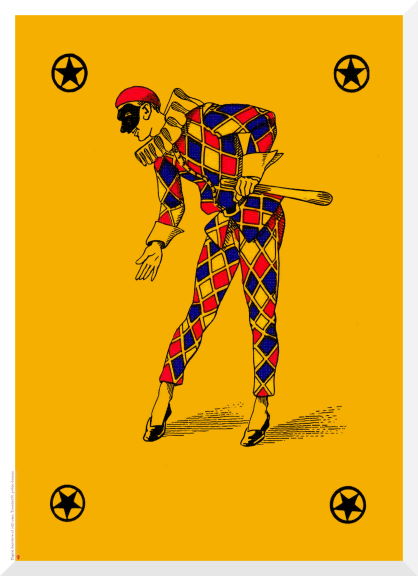
The man could not remember anything about his life except that he was once a cook in South Africa. The hospital eventually traced his brother who came to see him. His brother shakes him by the hand, gives him thirty Euros, then says goodbye. (From Doctor Tom Tom’s case studies in Amnesia)
When Arturo left the restaurant, the violinist was still playing. Walking out along the main drag towards the Palazzo del Governo, he came across some workers huddled around a fire in the municipal car park. From a supermarket trolley, they had erected a banner that read:
The Government is a dictatorship of the proletariat.
Across the road, on the steps of the provincial theatre, stood a squad of police officers. – Between the two opposing camps what remained of a kitchen unit, the metal rim that once sealed its plastic top uncoiling across the road. It seemed to Arturo quite absurd – the squad or small army of police officers watching, at a distance, and from the safety of the theatre steps, to see whether the striking workers would throw another childish fit and hurl their banner with its anachronistic and indeed contradictory message.
After they discharged him from the hospital, Arturo had not gone back to work. The tax office owed him a week’s holiday. With time on his hands, however, he did not feel like doing anything except idling in the flat and watching TV. It surprised him when he received the phone call from his ex. For a while, they behaved like two mice treading around broken eggs until something in him snapped.
“It feels like you are still judging me.”
“I’m not judging you, Arturo. Let’s face it. We both behaved badly. But don’t you think it’s time you stopped living in the past?”
When the phone rang again, Arturo wasn’t going to answer; then changed his mind. It was his sister wondering how he was getting on. “I’m just fine,” he said.
“No, you’re not.”
“Yes, I am. How are the kids?”
“Why don’t you speak to Corrado?”
His nephew, who was learning the piano, hummed the tune to jingle bells down the phone… His sister tried to make him promise to visit. Arturo did not promise anything; instead, he bought some almond cakes and a bouquet of flowers and got in his car.
Arturo drove along the coast road for about half an hour before turning inland towards the hills that lay back from the sea. Then, seemingly without paying attention, he turned away from the hills and drove down an increasingly narrow lane until he arrived at an old, flecked white gate. He got out of the car, bearing his gifts.
The old man came out to meet him; he was hanging onto his walking stick.
They embraced. “Vecchio.”
“Giovane.”
The old man smiled and patted him on the back.
The old man’s wife had cooked a simple tomato sauce. For the “second”, she had baked artichokes with breadcrumbs and mozzarella. A neighbour had given the old man a bottle of Primitivo. “It’s got a nice full body,” he said. “Like that of a Signora who’s been working the fields all her life.”
They ate their meal without saying much, except in sly allusions to old times. From time to time, they joked, as they used to, about local affairs as seen through a thin veil of tears.
The conversation took a philosophical turn. The old man declared he did not understand anything anymore and would be glad when he was gone.
His wife told him to stop talking nonsense.
The old man smiled as if he knew she was right. “If I come back again,” he said, “I would like it to be as a cricket.”
“Why is that?” their guest asked.
“Isn’t it obvious?” said the old man. “They are fast and hop round.”
“Well done,” said his wife. “They get caught in your hand and used for bate.”
“Woman,” he said, “what do you know about fishing?”
The old woman set the coffee on the table. They drank their coffees with the almond cakes and chewed the fat until it was time for the old man’s rest.
Arturo helped the old woman put away the things. When they had finished, he said he would go outside for a walk.
The old woman nodded.
“You better take your jacket,” she said. “It gets cold about now.”
Arturo slipped over the fence at the back of the house and cut across a wasteland onto a path that took him through a succession of small, canopied vineyards.
In the sky above him was a bank of cloud that began to make faces and disconcert him. As if, in that bank of cloud, he could discern the faces of the old gods that may still watch over us, he drew his jacket round him and hurried along the path between the fields.
The fields he passed ran uphill in tiers. If Arturo knew them well, it seemed he did not pay much attention to where he was going until, pulled out of his reverie, he came to a field full of spring flowers and long grass.
There, ahead of him was a copse. Approaching the copse, he saw the heads of some asparagus sprouting from the undergrowth. A shudder went down his back; Arturo began to weep.
How long did he lie on the ground – at the mercy of grief? – The field was wet and his clothes began to feel damp. In the end, he got up and went into the copse to pick the asparagus.
After this, he walked the length of a drystone wall, picking the asparagus in the cracks. Then he scoured the prickly pears in the field behind and picked the asparagus with great juicy heads that sprouted in their shadows. He climbed up onto an old stone dome roof and picked the asparagus among the brambles. Then he walked along the wall of a wet field and picked the asparagus from among the loose stones as dogs barked at him across the wasteland. When he had a big bundle in his hands, he tied them together with a leaf of grass and returned to the house.
The old couple was in the kitchen. “Look,” said the old woman, “he’s picked quite a bunch.”
Arturo put the bundle of asparagus down on the table.
“Vecchio,” said the old woman. “Don’t just sit there gloating… Go fetch the eggs.