
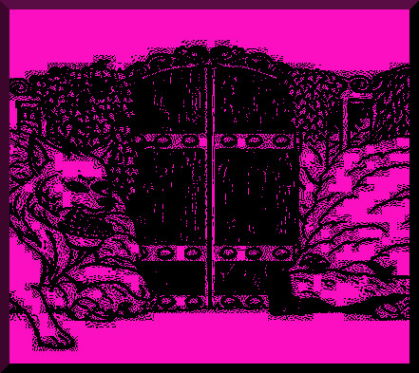
On Jeu du Mall
Who is not familiar with the common garden game played with mallet, ball and hoop? The Garden game is not exactly croquet, but its roots must surely be from the same tree. If I fear I must accept some responsibility for certain irregularities and anomalies in its evolution, the Garden game is known as Jeu du Mall, or in the corrupting slang of the gnomes it is called Germall. Or sometimes Gerball.
From Mr. Whizz’s Notebook, Concerning the Garden, a thing rarum.
Father Allen loved the Diocesan Walks. Grown-ups might have said that he enjoyed the company of Sister Sarah and Sister Shirley rather too much. If they ever had opportunity to lay eyes on the three of them, they would quickly realise what brought them together was a dry sense of humour and a love of singing the songs of the Carpenters and other folk singers of by-gone eras.
The ruse was quite simple. To get ahead of the party, they would take a short cut and find a quiet spot where they could practice, usually at an old, rundown bus shelter. “Ladies,” Father Allen would say, “it’s about time for an arpeggio.”
“Goodbye Joe, me gotta-go, me-oh-my ho!
Me gotta go pole the pirogue down the bayou.”
The next line came back sung by Sister Sarah and Sister Shirley:
“My Yvonne, the sweetest one, one- oh-my-oh
Son of a gun we’ll gave fun on the bayou
Jambalaya, crawfish pie and fillet gumbo.”
“One day, Father, you must bring your guitar.”
“Where am I going to put that under my cassock?”
“I guess not. The secret will out.”
Father Allen stopped to wipe his brow. When he turned around, he noticed the door at the back of the shelter was ajar. “Those impatient nuns,” he said to himself, “they must be out the back!”
He pushed through the door and found himself in a magical clearing. There they were, singing away.
“Father, we’re missing your tenor!”
“Hang on one second! I’ve dropped my hanky.”
He walked through a tree and back into the bus shelter, which was now full of the great and the good of the Diocese.
“Father, where have you been?”
“Away with the fairies!”
He slipped the hanky back into his pocket and went back through the door.
“I can’t understand where he’s got to,” said the Bishop. “I’ll call the police.”
“He’s with the sisters,” said the Deacon. “What harm can he come to?”
The Deacon’s words were a comfort to the seasoned walkers of the Diocese. When, however, Father Allen and the nuns came across the stretch of short grass, they were momentarily baffled.
“Unless I am very much mistaken,” said Father Allen, “it’s a croquet lawn.”
“Well, it doesn’t look very flat to me. And besides there is a tree in the way.”
“Obviously, you missed the hoop in the hole, Sister,” said Father Allen.
“The Father’s right,” said Sister Mary, “those furry things must be the balls… I am sure they would not object if we had a game.”
“Impossible,” said a voice.
“Why ever not?”
“We’re fully booked.”
Sister Mary realised it was one of the mallet heads speaking.
“But there isn’t anyone playing.”
“The players shall be arriving shortly.”
“Shortly?”
“They always come shortly,” said the grumpy head.
“Father,” said the Sister, “what time would you say it was shortly?”
Father Allen considered the question.
“I don’t know about shortly or even briefly. However,” he went on. “We left the house this morning after Matins. I suppose we have been on our feet for a good two hours. I would say, unless my stomach is very much mistaken, it must be after lunch. Shortly.”
“What did I tell you,” said the mallet, “the players shall be arriving shortly after lunch.”
“Quite!” said Sister Sarah. “We are the players. And it is shortly after lunch.”
Without further ado, she picked up the mallet and struck the furry ball in the direction of the hole in the tree.
“Oh, I say,” cried Father Allen. “Jolly good shot, sister!”
“Jolly good shot,” cried the mallet. “My head is killing me!”
“You’re lucky,” said Sister Mary, “the balls don’t talk back.”
“Oh, yes we do!”
“Who said that?”
“Me.”
“Who is me?”
“Me is an object pronoun. But you can call me Obi.”
“Obi?”
“Yes, I’ve been playing croquet all my life.”
“But you’re the ball, aren’t you?”
“Like you, I am one of the players.”
“In that case,” said Father Allen, “would you care for a song?”
“A song? What sort of song?”
“Well, we are rather fond of the Carpenters.”
“Are you related to the gnomes? They do a lot of woodwork around here. They even make the mallets.”
“How do they make them talk?”
“They don’t make them talk. They talk all by themselves.”
“I must protest,” said one of the mallets. “We are also players.”
“In that case,” said Father Allen, “we should all be singing a song.”
Upon his cue the nuns and he broke into:
“My Yvonne, the sweetest one, one- oh-my-oh
Son of a gun we’ll gave fun on the bayou
Jambalaya, crawfish pie and fillet gumbo.”
Someone began to clap:
“Oh, bravo! How absolutely delightful! Encore! Bis!”
The father and the two nuns turned about to observe an unusual looking gentleman walking into their midst. Dressed in the costume of bygone days, he wore a tricorn upon his rather handsome head and carried a musket at his shoulder.
He smiled and said:
“If you don’t mind my saying, so beautifully rendered. Such a charming arpeggio!”
“I do not think,” said the Priest, “we have the pleasure of your acquaintance, sir.”
“The pleasure is all mine…”
The gentleman bowed with an exaggerated sweep of his tricorn.
“The name is Charm,” he said. “Prince Charm.”
Father Allen introduced himself and the sisters. And the Prince bowed in turn to the Sisters Mary and Shirley.
“I see,” he said, “you have been introduced to the marvel of our game.”
“We are all familiar with the game of croquet,” said the Priest.
“Croquet,” said the Prince. “I am not familiar with that name. In these parts we call it Jeu du Mall.”
The speaker seemed to drawl over the final syllable before adding:
“On my mother’s part it might be referred to as Jeu du Mal, since it was only played on Thursdays. Since you are already acquainted with your croquet, perhaps you would care to join me in a friendly wager.”
Father Allen looked round at the nuns.
“Well,” he said, “I don’t see why not. We could play as three? – What kind of wager would you be proposing?”
“I would wager nothing other than your forgiveness.”
The priest hesitated, but then he saw the expression on the face of the gentleman in the tricorn, framed by a pair of eyebrows that seemed to knit together as he spoke.
“It is a most irregular wager. Normally, the sisters and I might wager the odd half crown.”
“Father Allen is just joking,” said Sister Mary.
“Yes,” said Sister Shirley. “He knows perfectly well it’s not those old denominations. The truth is, we usually wager a pound.”
“A pound?”
“I think that was the sum we came up with last time, wasn’t it, Sister?”
“That is quite right,” said the Sister Mary. “A pound it was to the winner.”
“So be it,” said the Prince. “A pound it is. – If I win, Father, I shall gain your forgiveness. If you Father and the Sisters win, you shall gain my pound.”
So saying, he produced a rather shiny looking coin from his purse.
“As a sign of good will,” he said, placing the coin in the hand of Sister Shirley.
Then he bowed once more and took up the mallet.
“After you, Father.”
But before the priest could execute his shot, a voice piped up:
“Don’t let him a play. He’s a cheat.”
“In fact, I wouldn’t trust him with a barge pole.”
“In fact, I would not trust him with a barge pole dipped in honey and treacle.”
To the piping voices the Prince reacted with surprising ferocity and hit the offending furry ball (it was Obi) from the field of play.
Having done this, he turned to the Priest once more. “You will understand, Father. The rules and practice of our Jeu Du Mall are somewhat different from your cricket.”
The Prince took up the mallet again and wacked the ball (it was Nobi, a rather quiet ball) through the hole in the tree.
“I do declare I have won,” he said.
He walked over to Sister Shirley and took the coin that he had placed in her hand.
“Now,” he said, “according to the terms and conditions of our wager, I believe I have earned your forgiveness, Father.”
If Father Allen was taken aback by the urgency of the request, he did not show it. The Priest stepped forward, taking the cross from around his neck.
The Prince took off his tricorn and his hair flowed down his back. One could not help admiring him in all his glory, nor could one fail to observe the pointy ears that now seemed to emerge from his glorious mane.
Slowly the wolf-man bent his neck.
“We are God’s creatures, my son,” said the Priest.
As he spoke, one of the nuns (it was Sister Shirley) was overcome and fainted.
“How strange is that?” said Laila.
She watched as the giant snail was lifted from a trail of lettuce that it was still half nibbling upon onto a kind of wooden sedan supported between two pannies.
Scouties and pannies were covered in the slime of the snail. The pannies had been struggling terribly with the slippery creature and became furious when it poked its head out of its shell and said:
“Oh, I say. Do be careful, won’t you!”
At first, it had been amusing, but now Laila was growing a little impatient.
“Do you think they’ll ever be able to manage it, Mr. Whizz?”
The wizard, who was momentarily lost in thought, replied:
“Indeed, it is quite a business moving giant snails around the woods. They are not the quickest, especially when it seems to them someone is trying to take them away from their home. However, if the pannies are unable to do their job, he will not arrive in time for the feast.”
“Must the snail be at the feast?”
“All creatures of the Garden must be at the feast.”
“Even the wolves?”
But the wizard did not answer Laila’s question.
The pannies slipped in the giant snail’s slime and the poor snail slipped from their hands.
“Eek!” he cried.
Slime oozed over the chair and they all fell in a heap.
“Crikey, you lot!” cried the Mistress. “What a shower!”
“It was Tin’s fault,” said the panny.
“It was Ton!”
The argument became progressively petty with insults hurled from left and right and right of left and left of field.
“Yer tinder-headed tin man!”
“Yer ten-ton tessy!”
Exasperation was beginning to furrow the Mistress’s brow when, all of a sudden, there was a great howl from the trees. This was followed by an answering howl from further down the path.
Everyone froze.
All except the Mistress.
She picked up her bow and sprang into action.
“Mr. Whizz!” she called over her shoulder as she ran. “Come on!”
Mr. Whizz geed up Beautifully and galloped off after her.
Without thinking, Laila had turned Handsomely around. She was already gaining on the wizard when she saw Cyril.
“What’s happening, Cyril?”
“Nasty grrs!” he cried. “Smarm’s work!”
They had gone but a short way when she saw a huge wolf.
The wolf was in the middle of an overgrown croquet lawn with a series of hoops that ended in one big hoop that went through the bottom of a tree. Standing by the tree was a priest and a nun. Another nun, who appeared to have fainted, was lying on the ground between them.
The Mistress raised her bow and shot an arrow that landed by the large front paw of the wolf.
The wolf swung round and snarled.
“Stop this!” cried the Mistress. “I forbid you to do it.”
“And what is it to you, Mistress of the woods?”
Though he was a wolf, Laila was sure that it was indeed Smarm. His speech was no longer smarmy but snarly.
“Smarm! He is a gentleman of the cloth.”
“If he is a gentleman of the cloth, I am a gentleman of the woods.”
“Then you must behave like a gentleman of the woods.”
“Is it now a crime,” said the wolf, “to ask forgiveness from a priest?”
The wolf swung back around and glowered at the priest who stood his ground, holding the cross before him.
“Smarm!” cried the Mistress. “If you dare to touch him, I will let loose this arrow, and it will strike your heart.”
The tension in all was unbearable, but most especially in Laila. Who would prevail? The wolf, on the one hand, or the Mistress, on the other? But before the arrow could pierce the heart of the beast or the beast could pounce upon his victim, a bike came busting onto the croquet lawn. Dodging hoops and protesting balls and mallets, the rider slammed on the brakes and swerved to avoid crashing into the wolf.
For a moment it seemed the wolf did not know which way to turn. He looked one way and saw the biker. He looked the other and saw the Mistress with her bow. Suddenly he sprang and leapt over the biker. His great paws extending towards the safety of the trees.
An arrow whistled through the air.
The Mistress did not hesitate – gathering up her arrow where it had landed and calling to the rider on the bike.
“Fair rider, we meet again,” she said. “However, there is no time to lose. I must go after the wolf.”
And so she did. Like a biker with wings, she flew after the beast.
Meanwhile, after all that excitement, which had many hearts, including the youngest and yangest at heart, still palpitating, Mr. Whizz had gone to assist the priest and the nuns.
“I have a little cordial,” he said. “which you will find most reviving.”
Hardly had she raised head than the nun saw a little green chap poking his head out between the white legs of a unicorn and she fainted back down again.
“I must say,” said Father Allen. “This has been quite enough excitement for one day. And not only for Sister Shirley.”
“Oh, father,” said Sister Mary, “I am sure we shall all soon be coming around with the aid of this kind gentleman’s cordial.”