
On Music
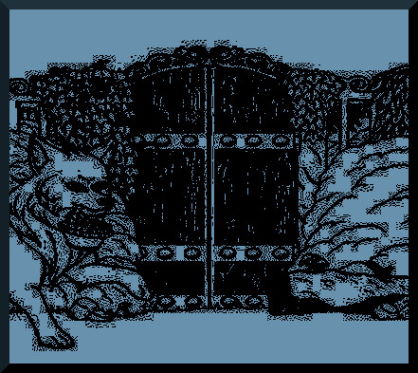
Once upon a time the Garden was all black and white. When Anatole arrived here, he brought with him the colour of otherworldly music. First, there were the records, which the gnomes called CRACKLES. “What is this strange sound?” they asked as their legs began involuntarily to dance. “Why, this is Dixie Land,” replied Anatole. “What does a dixie look like?” the gnomes returned. “It’s not what it looks like,” said Anatole, “it’s what it sounds like.” “Here,” Anatole would say, “this is blue grass.” The gnomes would protest: “The grass isn’t blue, it’s green.” I would concur: the grass is definitely green. But the music can be the blues, or red-hot salsa, or indeed any other colour of the rainbow.”
From Mr. Whizz’s Notebook: Concerning the Garden: a thing rarum.
“You cannot see the wood for the trees,” René had said as they were walking in the countryside one day. “That is such funny expression of the English. It’s not logical, not like French. At least in French, you know where you stand. When it is clear, it is clear. And when it isn’t, it is just dark.” Mercedes laughed and said: “That isn’t the point, is it? – Here it is not dark.” “You are right, Mercy,” René said. “It is not dark. It is very light and bright, especially with you here.”
When they had crossed the stream and entered the woods, Mercedes had taken heart, as she always did when she thought of René. Mr. Brownlow had promised to take them somewhere they would be safe from wolves and smarmers. And she had believed him. She had been encouraged by his gentle manner and air of calm as he peered through his Eye or prodded the ground with a stick. But, after a while, that certainty had begun to leave her. Wherever she looked, there were always trees and only trees. She found it all quite dispiriting. And feeling dispirited, she began to think of René and what had happened to him. Would she ever find him in this dark wood?
“Which way should we go now, Mr. Brownlow?” she said. “It all looks the same to me. You can’t see the wood for the trees.”
Mr. Brownlow puffed out his cheeks and considered the question.
“This is no place for the eye, or its way of seeing,” he said. “However, I still have other ways and means of seeing at my disposal.”
He took off the little rucksack he had been carrying and began to rummage around in its pockets.
“My dear,” said Mildred, who, in spite of the admonishments of the talking stick, was still hobbling, “will you forgive me if I sit down?”
By the side of the path she found a log where she could rest her foot.
“Thank Gordo for that,” said the talking stick. “What you need now is a nice cup of tea.”
“Oh, that would be wonderful,” said Mildred. “What I wouldn’t do for one now!”
“A coffee would be nice,” said Mercedes. “A shot of espresso with a spoonful of sugar to take away the bitterness.”
“Frankly, I’d rather have a cup of tea,” said Mildred, “especially it’s made from my old teapot. It’s got a crack in it, but it makes all the difference. – At least, that’s what George says. It’s because of the crack. And I say to him. George, you’re talking perfect rot. It has nothing to do with the crack. It’s because I always leave some leaves in the bottom. – I say, Mr. Brownlow, what on earth are you doing?”
The little man was lying with his ear to the ground. Attached to his ear was a strange looking instrument, made from some kind of animal horn.
“My aunt Dahlia used to have one of those strapped to her bath chair, except hers was made of brass. Do you think Mr. Brownlow is deaf?”
“I don’t think so,” said Mercedes. “It must be his other way of seeing.”
“Well,” said Mildred, “I don’t see what the similarity is between seeing and hearing. Either you need an ear trumpet because you’re deaf, or you need an eye glass because you’re blind.”
“I am neither blind, nor am I deaf,” the little man said. Suddenly, cocking his ear to the trumpet, he cried:
“We must get off the path. They’re coming.”
“Who are coming?”
Before they had received an answer, Mr. Brownlow had thrown himself into a bush.
Something like a cackle – not of hyenas or witches or even hens – but something altogether stranger was coming down the path to their left.
Mercedes was suddenly afraid.
“What do you suppose it is?”
“Well, I don’t care if it’s a howling wolf,” said Mildred, “I’m not moving from this spot.”
Coming into view was a troop of little green men, all carrying something: kitchen utensils or musical instruments that seemed to contribute to the cackle Mercedes and Mildred had contrived to hear.
“Crikey! Are you the caterers or the jazz band?”
“Actually, we are both,” said the head gnome, putting down a kettle drum. “If you cook, you have to join our band. If you sing, you have to cook.”
Mercedes laughed.
“What if you can dance?”
“Show us your moves, little sister.”
“Give me your cue, little greenie.”
The gnome looked baffled.
“We need Nose. Nothing happens without Nose.”
“Who on earth is Nose,” said Mildred, “when he is at home?”
The gnome looked even more baffled.
“Nose is Nose. I suppose,” he said. “But others call him Anatole.”
“Anatole!” someone cried. “Has anyone seen Anatole? Or a gnome called Vigo?”
Mildred looked up and saw a young girl riding on what appeared to be a white horse with a horn. The white horse with the horn was a very handsome looking beast. Although the girl did not immediately look like an automatic rider of white horned horses or heaven forbid unicorns, dressed as she was in jeans and trainers, she seemed to sit very assuredly and comfortably upon it.
Walking behind the girl on the unicorn was a man dressed in a cassock and two women wearing habits. First the smarmers in their Hornblower costumes and now this: a girl on a unicorn, two nuns and a priest. “Well, I must say this all getting very odd,” she said to herself and the world at large.
“A top of the afternoon to you,” said the priest as he come towards them. “My name is Father Allen and these are Sister Sarah and Sister Mary. If you think I and Sister Sarah are with the fairies, I warn you Sister Mary can also be somewhat contrary.”
“Honestly, Father Allen, you do like joshing! – Pleased to meet you -.”
“Mildred.”
“And?”
“Mercedes.”
There was a nodding of heads and shaking of hands among the grown-ups who launched into a rather awkward sort of chatter typical of grown-ups who don’t quite know what to say to each other unless there is a bit of a walnut cake or a glass of sherry to hand. The young girl and rider of unicorns, however, had far more pressing business with the gnome who, it turned out, was the very person, Nose excepting, she had been charged to communicate with.
“Thank God, I’ve found you, Vigo,” she said. “Mr. Whizz told me to tell you that he’s coming as quick as he can. Only the pannies are having terrible trouble with the giant snails. They keep falling and slipping off their chairs, and I don’t know how long it’s going to take them to get here. Have you managed to bring the extra pots and pans needed for the feast?”
“No problems,” said the gnome called Vigo.
“We’re on top of it,” said another gnome, who was his brother Figo. “We even brought some thrashers, thumpers and twangers.”
As if to prove it, various gnomes thrashed, thumped and twanged the instruments they were carrying.
They giggled and whooped with delight.
“Not bad that one!”
“Yeh, makes a real thump.”
“What about that twang!”
“Twangier than Twang! Ha Ha!”
“What about Anatole?” said Laila. “Mr. Whizz gave me specific instructions for Anatole. There was very important information that I was to give to him regarding the feast. Let me see, it’s on this piece of paper…”
Vigo shrugged.
“Word was sent, but Nose’s not his best at this time of the day.”
“In fact,” said Figo. “Nose can be a bit of handful in the afternoons.”
“Not his usual charming self.”
“Oh, no,” said Laila, suddenly alarmed. “He’s not a smarmer, is he?”
“Nose, a smarmer! – You hear that, lads. This young lady here thinks Anatole is a bit of a smarmer.”
There was lots of chuckling and tee-heeing in the ranks.
“He’d sooner hit one over the head with his frying pan than have anything to do with that lot.”
“Don’t worry, Miss! Nose may not be the most charming individual, but one thing for sure is he is not smarmy.”
“Not like Smarm.”
“Smarm is smarmier than all of ‘em put together.”
“Maldita sea!” cried the woman in the ball room dancing outfit. “I had the misfortune to meet Prince Smarm.”
“A fearsome beast,” said Father Allen.
“Oh, I do agree,” said Sister Sarah, “Though I must admit I did think he was rather fetching in his uniform.”
“Oh, really,” said Sister Mary, “I can’t say I remember the uniform.”
“Never trust a man in a uniform,” said Mildred.
“The only good smarmer is a dead smarmer,” said one of the gnomes.
Amid the banter, the party moved off as Laila, who was taking her responsibility as Mr. Whizz’s representative very seriously called to the hobbling, old lady:
“Are you alright, Madam?”
“Oh, yes, don’t worry about me. It was Mr. Brownlow I was worried about.”
Mildred turned around and called:
“I say, Mr. Brownlow. Where are you?”
But there was no answer.
“How unfortunate! The little fellow has disappeared.”
“Surely not,” said Mercedes. “We must look for him.”
They all started calling his name when the little fellow popped his head out of a bush.
“Have they gone? – Crashing about like that they never going to keep out of Smarm’s pot.”
“Have you met our friend, Laila? – Mr. Brownlow.”
The little fellow bowed.
“Enchanté, mademoiselle.”
“I’m sorry,” said Laila, “I don’t speak French.”
“That’s just as well,” said the little fellow. “As folks say around here, if you’re French, you are half way to being a smarmer. And it’s better to stay the half you are.”
Laila was at the head of the party on Handsomely as they came in sight of the clearing. Lying on a bank were several kipping gnomes. In their midst was a large lumpen figure with a great conk of a nose with several tufts of hair growing out of it. He was dressed, she noted, in a rather snazzy pair of chef’s trousers, and he had a pair of metal-capped boots.
The arriving gnomes called out:
“Wake up, lazybones!”
The gnomes on the bank began to stretch and yawn. But the lumpen figure remained blissfully unaware of the activity around him. Even the rather cheeky gnome who had pushed a stalk of corn under his conk.
“Wake up, Anatole! Lazybones!” the gnomes cried as one. “You got a visitor!”
“Nose, you’ve got a visitor and she’s come from the Minister!”
“The Minister! She’s come from the Mistress, you ninny.”
“I know that, only I was just thinking of a rhyme. Is that a crime?”
“Forget about your rhymes. We’ll all get it if he doesn’t wake up.”
One of the gnomes (his name was Clatter) said:
“There is only one thing for it. – Stand back everybody!”
He stood over Anatole with his cymbals and went crash!
Anatole sat up and blinked. But as soon as he did this, he slumped back down onto the bank and closed his eyes. Once again Clatter crashed the cymbals. Once again Anatole sat up and blinked. This time he rubbed his eyes and looked groggy-eyed at Clatter.
“Didn’t I kick you out of the band?”
“To quote a well-known critic called Nose, the cymbals are not only symbolic, but the quintessence of the band. You called it the Art of Noise, whatever that means.”
Anatole opened his mouth and yawned.
“You’re confusing him,” said Vigo. “He’s got to concentrate.”
“Why did you say?”
“I said the Mistress has ordered a feast.”
“A feast?”
“That’s right, Nose. Someone stole all the strawberries. The feast is tonight.”
Laila handed Anatole her note from Mr. Whizz. He stared at it for a few seconds before he began to focus on the words.
“Dear Anatole,” he read, “I have entrusted Laila who will be riding upon Handsomely with a matter of some urgency. Unfortunately, and most regrettably, it has come to the Mistress Dido’s attention that the very animam sanguinis, or lifeblood of the Garden, namely its strawberries have been stolen. Accordingly, the Mistress Dido has ordered a feast for this evening in the place we all know as the Great Clearing. While she pursues investigations of her own, she is relying on your usual inspiration for the first and second course. She trusts that your ingenuity will not desert you for the dessert. However, I will note that only yesterday morning I observed some gooseberries growing not far from your kitchen in the place you and I have been accustomed to observe them.”
“Gnomes, you are making no sense. Tonight?”
One of the gnomes from the kitchen huffed:
“There’s no time for practice.”
“Forget about practice. We are going to need our skates if we are going to get any food out tonight.”
“Skates, Anatole?”
“It’s an expression, you mules. Skates, dancing shoes!”
“Dancing shoes, Anatole! Are you mad? We’re musicians, not dancers.”
“Nose has finally flipped his lid.”
“Excuse me,” said Mercedes, who had been trying to take in the chit-chat between the gnomes and the man called Nose. “Aren’t you the cook?”
“No, I’m the chef.”
“Ah, I get it,” said Mercedes. “A professional. I need your cue.”
“What cue?”
“If you want me to dance, you have to cook.”
“What dance?” said Anatole, swivelling round on his boot.
“How about a stomp?”
“A stomp…”
Anatole’s nose began to twitch. From somewhere deep down in his boots came the rhythm of the stomp. He began to beat the rhythm out on the boards of the platform. Mercedes was the first to picked it up. As she ran with it, Mildred found her legs and started singing in a low gravelly voice:
“Ah, caught you smiling at me,
That’s the way it should be,
Like a leaf is to a tree, so fine.
Ah, all the good times we had,
I sang love songs so glad
Always smiling, never sad so fine.”
“Mesdames!” cried Anatole, suddenly alive to the magic of the moment. “Such talent! Such a voice!”
“Thank you, Monsieur.”
“Now, I am awake. Let us repair to the kitchen,” he thundered.
The others followed as he strode off down the little path that ran along the side of the great clearing.
Anatole’s kitchen was on a raised platform. There was a cooker as you would expect, and a large stone sink at the bottom of a tree that loomed over the platform. Upon its branches hung sheets of music. The sheets of music were evidently necessary, as upon the platform there was a wooden drumkit (with the Anatole and the Coconuts in crazy paint on the skin of the largest drum) and an upright piano that one might find in a pub or a bar. Two guitars were propped up against a most unusual object, known as The Voltaic Pile[1] by means of which the Coconuts, like a certain fabled folk singer, had gone electric several years ago.
“But Anatole, it doesn’t look like a kitchen.”
“What does it look like to you, then? We have a cooker. And a chopping table.”
“If you ask me, it looks more like a stage set.”
“I will let you into a secret, Laila,” said the chef. “The Coconuts cannot and will never cook without rhythm, or blues, for that matter.”
“Who are the Coconuts?”
“The best ingredients of every dish we cook.”
“Saucepans!” Anatole balled.
“Saucepans!” came back the gnomes.
“Cashew Nut.”
“I’m here,” said a gnome, handing Anatole a saucepan.
He took it up in his big hands and gave it thwack.
“Ladies and Gentleman, welcome to the kitchen. And on stage tonight the incomparable Cashew with his double bass.”
A twang rang out from Cashew’s double bass.
“No one is better than Brazil, on guitar.”
A tall-hatted gnome took up the riff on his star-shaped guitar.
“Followed by the irrepressible Wally, on piano.”
“But that’s not a nut,” said Laila.
“Walnut, you ninny. And on trombone we have the highly active Al.”
“He’s definitely not a nut,” said Laila as a flat-capped gnome gave a blast of trombone.
“Coconut,” cries Anatole, “why haven’t you come in yet? Without your holy seasoning, this number’s got no sauce.”
Coconut blew a raspberry on her clarinet.
Laila burst out laughing.
But someone in the group was not laughing. It was Mercedes who had burst into tears.
“What’s the matter, Miss Mercy?”
As a matter of fact, it had all proved too much for Mercedes. The pleasure of performing the stomp had reminded her of René. How much she would have loved to have him dancing beside her.
“I am so sorry,” she blubbered. “I am missing my boyfriend, René.”
“Never mind, Miss,” said Billy Brownlow, “I know just the number.”
Then nodding to Anatole and the band, he put his harmonica to his lips:
“This one’s called Dipper Mouth Blues.”
The band burst into life and the Voltaic Pile shook as Anatole, joined by a cheerier Mercedes, stomped around the stage.
“They’re all nuts,” said Laila to the Father Allen and the nuns, who, like her, had all sat down on the bank to watch the show.
“I quite agree, young lady. They are nuts. But very tuneful nuts.”
“Speaking of which I wonder if they have pistachios.”
“Now, Father,” said one of the Sisters, “you know how they disagree with your stomach. Let’s just sit back and enjoy this number.”
[1]An invention of Venables’ devising, consisting of a series of zinc and coppers piles separated by felt spacers soaked in salt water acting as the electrolyte.